
Autumn rain, falling leaves, and the natural shrink–swell cycle of London clay create a predictable but manageable drainage challenge for homeowners across Essex and Hertfordshire. Blocked gullies, shifting pipe joints, and overwhelmed soakaways are common this time of year—but most problems can be caught early with the right maintenance habits and a timely CCTV drain survey.
Autumn has a lot going for it. Crisp mornings, colour in the hedgerows, an excuse to eat soup. What it’s less good for is your drainage system. The first big downpour after a dry spell, combined with gutters full of soggy leaves and ground that’s spent three months baking and contracting, is a recipe for blocked drains, gurgling toilets, and lawns that squelch for days after the rain has stopped.
If you live in Essex or Hertfordshire—or anywhere sitting on London clay—this isn’t just bad luck. It’s geology. And once you understand why it happens, it’s much easier to stay ahead of it.
Why autumn rainfall causes more drain problems
Summer in the UK might not always deliver the sunshine we’re promised, but even a dryish spell is enough to harden the ground, clog gutters with debris, and leave surface drainage systems full of accumulated grime.

Then the autumn rain arrives—often in heavy, concentrated bursts—and overloads everything at once. Gullies that were already half-blocked with silt and leaf debris can’t handle the volume. Surface water has nowhere to go quickly. Foul and surface water drains that share combined systems back up under the pressure. The result is the kind of overflow that tends to happen on a Sunday evening when every plumber’s phone goes straight to voicemail.
Autumn leaves belong in the compost, not your gully—but every year, millions of them end up exactly there.
London clay explained (without sending anyone to sleep)
London clay is a thick, marine sediment deposit that sits beneath much of Greater London, Essex, and parts of Hertfordshire. It’s dense, heavy, and—crucially—highly responsive to changes in moisture content.
In dry weather, clay loses water and contracts. Gaps open up in the ground, soil shifts slightly downward, and anything buried in it—pipes, inspection chambers, drain runs—moves with it. Then when the wet weather returns, the clay absorbs water and expands again. This continuous cycle of shrinking and swelling is what surveyors call shrink–swell, and it’s the single most significant cause of ground movement and subsidence in the UK.
According to Hamblin Sullivan Associates, London has the highest shrink-swell clay hazard in the country, with areas including St Albans, Hatfield, and Potters Bar in Hertfordshire among the most at-risk locations. For homeowners in these areas, it’s not a question of whether the ground moves—it’s a question of how much, and what’s in the way when it does.
How shifting clay leads to pipe movement and damage
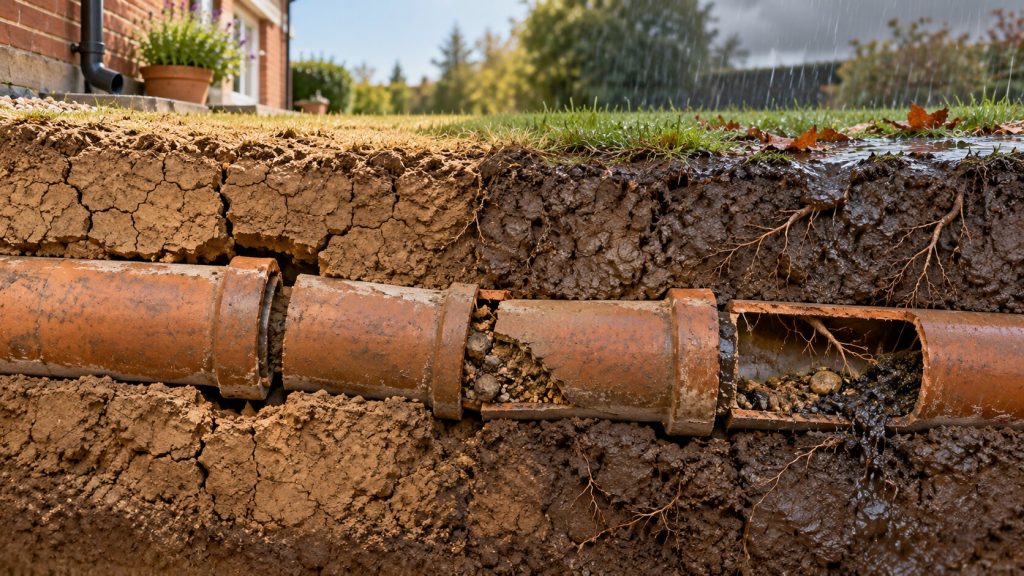
Underground drainage pipes weren’t designed to flex. They rely on stable ground to hold them in alignment, and the joints between sections—especially in older clay or concrete pipe systems—have a limited tolerance for movement.
When the ground beneath a pipe contracts in summer and then swells again through autumn and winter, those joints can shift, separate, or crack under stress. Even small misalignments are enough to let in fine soil particles, allow root ingress, or create a partial blockage that worsens with every passing season.
Shifting soil pipe cracks are particularly common near large trees, at changes in pipe direction, or where pipes run beneath driveways and hard landscaping that adds extra load. Once a joint is compromised, it rarely fixes itself—and it tends to get worse faster than you’d expect.
Warning signs your drains are struggling
Catch a drainage problem early and it’s usually a straightforward fix. Leave it until it fails properly and you’re looking at emergency callouts, potential ground investigation, and a much larger bill.
Watch out for:
- Slow drainage in sinks, baths, or toilets that gets noticeably worse after rain
- Gurgling sounds from drains or toilets when water empties elsewhere
- Unpleasant smells from external gullies or inside near inspection points
- Toilets bubbling or sinks backing up during heavy downpours
- High water marks inside manholes visible through the cover
- Soggy patches or pooling in the garden that take days to clear after rain
Any combination of these—particularly if they’re getting worse year on year—is worth investigating properly rather than hoping for the best.
Autumn drain maintenance checklist
Spending an hour on drain maintenance in early autumn is genuinely one of the better uses of your time as a homeowner. Here’s what’s worth doing:
- Clear leaves and debris from gullies and drain grates regularly through October and November
- Check gutters and downpipes are discharging properly and not overflowing onto paths or foundations
- Don’t pressure-wash debris into outdoor drains—sweep it up and bin it instead
- Use drain-friendly habits in the kitchen: fats, oils, and coffee grounds go in the bin, not down the sink
- Lift accessible manhole covers (with gloves and care—never enter a chamber) to check water levels and look for obvious blockages
- Avoid harsh chemical drain cleaners as a long-term fix—they can damage older pipework and rarely solve the underlying cause
Good autumn drain maintenance in the UK doesn’t need to be complicated. A bit of preventive attention now saves a lot of disruption later.
Soakaways in wet weather: when ‘it’ll drain eventually’ becomes ‘it definitely won’t’
A soakaway is a buried drainage system designed to disperse surface water slowly into the surrounding soil through perforated pipes. They’re common in properties that can’t connect to mains drainage for rainwater, and they work perfectly well—until they become saturated or silted up.
Clay soils are the worst possible neighbours for a soakaway. Because clay drains so slowly, a soakaway surrounded by it has very limited capacity to disperse water during sustained wet weather. Add years of accumulated silt in the pipes and you’ve got a system that struggles in light rain and fails completely in autumn downpours.
Signs of soakaway problems include persistent pooling in the garden, a waterlogged lawn that stays soft even when it hasn’t rained for two days, and surface water that simply refuses to shift. If any of that sounds familiar, soakaway clearance in Hertfordshire and Essex is a service we carry out regularly—and it’s worth sorting before winter sets in properly. Give us a ring and we’ll talk through the options.
When DIY isn’t enough: the smart time to get a CCTV drain survey
There’s a point at which clearing your gully and using a drain rod stops being enough. Repeat blockages, persistent smells, drains that block again within weeks of clearing—these are symptoms of an underlying issue, not a surface one.
A CCTV drain survey is the most reliable way to find out exactly what’s happening inside your pipes without unnecessary digging. A small, high-definition camera is fed through the drain run, and the footage is reviewed to identify blockages, root ingress, cracked sections, displaced joints, or deformation caused by ground movement.
The value isn’t just in seeing the problem—it’s in knowing exactly where it is and what type of repair will actually fix it. We use state-of-the-art CCTV equipment to inspect drain lines across Essex and can advise on the most cost-effective solution, whether that’s jetting, root cutting, relining, or in some cases, targeted excavation.
If you’re seeing repeat blockages after rain, we can run a CCTV inspection to confirm whether it’s a simple blockage, root ingress, or a damaged section of pipe.
Repair options that suit clay-ground problems
Not every drain problem needs a digger. The right repair depends on what the camera finds:
- High-pressure jetting is effective for clearing silt, grease build-up, and compacted debris—and can also cut through finer root growth in many cases
- Root cutting tackles more established root ingress, though if roots have found their way in, they’ve usually done so through a crack or displaced joint that also needs addressing
- Drain relining is a no-dig repair option that inserts a new structural lining inside the existing pipe, sealing cracks and displaced joints from the inside. It causes minimal disruption to driveways, gardens, and landscaping, and is particularly well-suited to the kinds of joint movement and fracturing that clay-ground conditions cause
- Excavation is sometimes unavoidable—particularly where pipes have collapsed or where sections need full replacement—but it’s rarely the first option we’d propose
We’ll always recommend the least disruptive approach that genuinely solves the problem. Patching over a structural issue with jetting alone tends to just delay the same call a few months down the line.
Get ahead of autumn drain problems
Autumn rain and shifting London clay create a predictable pattern of drainage stress for properties across Essex and Hertfordshire. But predictable means manageable—with a bit of maintenance, an eye for the early warning signs, and the knowledge of when to bring in professional help.
If your drains are slowing down every time the weather turns, don’t wait for a full overflow to force the issue. We’re on call 24/7, we can typically be with you within 90 minutes, and there’s no call-out fee and no extra charge at weekends. Whether it’s a simple clearance, a soakaway investigation, or a full CCTV drain survey, we’ll identify the cause and give you a straight answer about the best fix.
Give us a call on 020 3675 7174 or request a free quote via our website. All our drain work comes with a 100-day guarantee—because a proper repair shouldn’t need a follow-up call before Christmas.
Frequently asked questions
Why do my drains block more when it rains in autumn?
Autumn rain tends to arrive in heavy bursts after a dry summer, overloading systems that have accumulated leaves, silt, and debris over the warmer months. Gutters, gullies, and drain runs that weren’t cleared through summer often can’t handle the volume—leading to surcharging and backups.
What is London clay and why does it affect drainage?
London clay is a dense, moisture-sensitive soil found across much of Greater London, Essex, and Hertfordshire. It shrinks when dry and swells when wet—a cycle that causes gradual ground movement. Underground pipes buried in clay shift with this movement, leading to displaced joints and cracks over time.
Can shifting soil really crack underground pipes?
Yes. The repeated contraction and expansion of clay soil places stress on pipe joints, particularly in older clay or concrete pipework. Over time, joints can separate, sections can crack, and even minor misalignments can allow root ingress and partial blockages to develop.
How can I tell if it’s a blockage or a cracked drain?
A simple blockage usually clears with jetting or rodding. If blockages keep returning—especially in the same location—or if you’re getting smells or soggy ground without an obvious cause, a cracked or displaced pipe is more likely. A CCTV drain survey will confirm which it is.
Is standing water in my garden always a soakaway problem?
Not always. Pooling can result from compacted soil, broken surface drainage, or a blocked gully. But if water persists for days after rain, especially in the same area year after year, a failing or silted-up soakaway is a likely cause—particularly on clay ground where natural drainage is already slow.
How often should drains be cleaned in the UK?
For most domestic properties, an annual check and clean of gullies and accessible drain runs is a sensible baseline. Properties with large trees nearby, older clay pipework, or a history of blockages may benefit from more frequent maintenance.
Are chemical drain cleaners safe for outdoor drains?
Occasionally they can help with minor grease or organic build-up, but they’re not a reliable fix for serious blockages and can damage older pipework with repeated use. They do nothing for structural problems like cracks or root ingress, and can be harmful to the wider drainage environment.
What happens during a CCTV drain survey?
A trained engineer feeds a small, high-definition camera through the drain run from an access point such as a manhole. The footage is recorded and reviewed in real time to identify blockages, pipe condition, root ingress, or structural damage. You’ll receive a clear explanation of what was found and the recommended next steps.
Can you fix cracked pipes without digging up the driveway?
In many cases, yes. Drain relining is a no-dig repair method that installs a new structural lining inside the existing pipe, sealing cracks and displaced joints without excavation. It’s suitable for a wide range of crack and joint displacement issues and causes far less disruption than traditional excavation.
Do you offer emergency drain unblocking and is the work guaranteed?
We provide 24/7 emergency drainage cover across Essex and aim to arrive within 90 minutes. There’s no call-out fee and no additional charge for weekend callouts. All our drain work is backed by a 100-day guarantee, so if the same issue recurs within that period, we’ll be back to sort it.